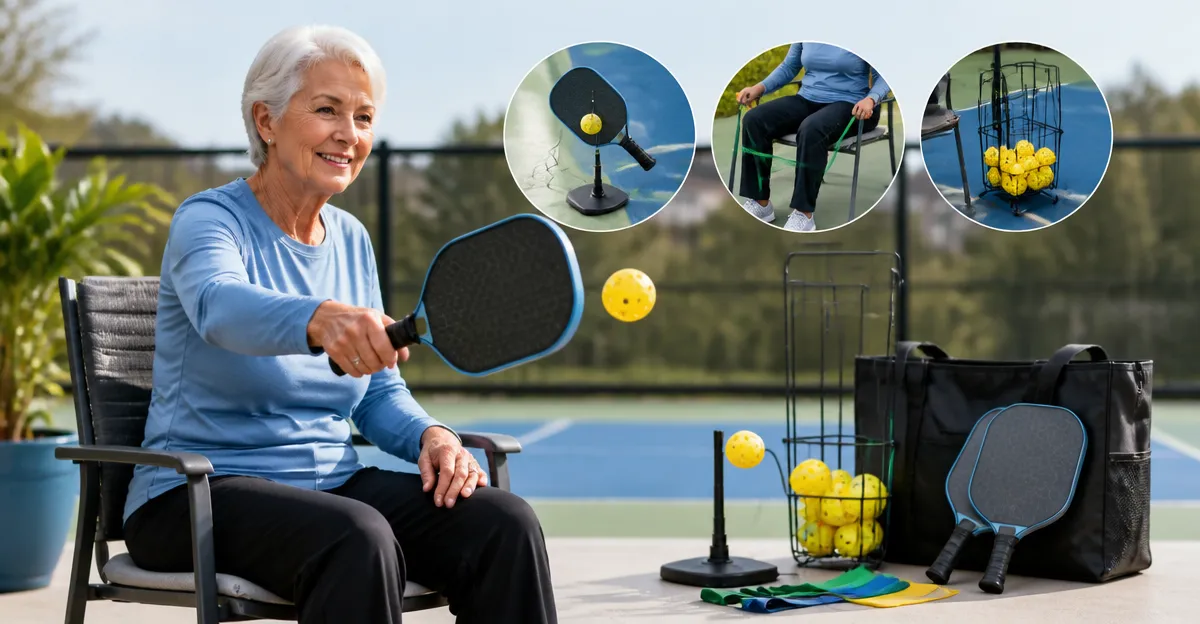
The Ultimate Guide to Seated Pickleball Training Aids for Seniors with Limited Mobility
Introduction
Seated pickleball training offers a safe pathway for seniors who experience reduced balance or joint discomfort. This guide explains the benefits of seated drills, outlines essential concepts, and presents carefully selected equipment that enhances skill development while protecting the body. Readers will learn how to evaluate training aids, integrate them into a regular routine, and avoid common pitfalls. By the end of the article, one will possess a clear roadmap for maintaining competitive enjoyment without compromising health.
Background and Context
Pickleball has become the fastest‑growing sport among adults over sixty, largely because the court dimensions are modest and the paddle is lightweight. However, rapid lateral movements and low‑impact jumps can challenge individuals with arthritis, osteoporosis, or limited core strength. Seated training mitigates these stressors by allowing the player to focus on paddle control, spin, and reaction time while remaining in a stable chair or bench.
Key physiological concepts support seated practice. First, the principle of specificity states that drills must mimic the motor patterns of actual play; seated rebounders replicate the ball trajectory without demanding full‑body weight transfer. Second, neuroplasticity suggests that repetitive, low‑intensity practice can rewire neural pathways, improving hand‑eye coordination even when the lower limbs are not actively engaged. Finally, progressive overload can be achieved by adjusting height, angle, or resistance, ensuring continual adaptation despite a seated position.
Understanding these foundations helps seniors select equipment that aligns with therapeutic goals and personal preferences. It also clarifies why certain features—such as height adjustability, dual‑sided panels, or audible cues—are particularly valuable for this demographic.
Seated Training Strategies
Effective seated training revolves around three core strategies: precision targeting, reaction‑time conditioning, and spin mastery. Precision targeting involves setting the rebounder at a comfortable height and striking the ball to specific zones on the panel. Reaction‑time conditioning uses rapid, alternating rebounds to simulate unpredictable volleys, encouraging faster decision making. Spin mastery focuses on paddle angle and wrist snap, which can be practiced with interchangeable screens that guide the correct grip.
Each strategy can be executed with minimal space, making it suitable for living rooms, community centers, or outdoor patios. Seniors should begin with short sessions of five to ten minutes, gradually increasing duration as endurance improves. Incorporating breathing techniques and gentle stretching before and after practice further reduces the risk of muscle strain.
Recommended Products for Seated Training
The market offers several tools that complement seated drills. The following products have been selected based on durability, adjustability, and positive user feedback from older athletes.
- Paddyn Dual‑Sided Rebounder – A height‑adjustable, freestanding board with high‑density PVC panels that deliver consistent rebounds on both sides. The dual‑sided design enables multi‑angle practice, effectively halving the time required to develop reflexes. Rated 4.8/5.0 from seven reviews, it is praised for wind resistance and easy portability.
- SpinPro Pickleball Trainer – This tall, stable trainer features interchangeable screens that force the correct paddle angle for topspin, slice, and sidespin shots. A built‑in rebounding ball allows rapid repetitions without chasing stray balls, which is ideal for seated practice. Rated 4.4/5.0 from twenty‑eight reviews and priced at $299.00.
- SKLZ Reactive Catch Trainer – A lightweight, three‑pointed foam target that can be tossed and caught while seated. Color and audible cues train reaction speed and decision making across multiple sports, reinforcing hand‑eye coordination essential for pickleball. Rated 4.5/5.0 from eight hundred‑eighty‑one reviews and priced at $29.99.
Comparison and Selection Guide
Choosing the right seated aid depends on three primary criteria: mobility limitation, training focus, and budget. The table below summarizes how each product aligns with these factors.
| Feature | Paddyn Dual‑Sided Rebounder | SpinPro Pickleball Trainer | SKLZ Reactive Catch Trainer |
|---|---|---|---|
| Adjustable Height | Yes – easy crank mechanism | No – fixed height 67 in | Not applicable |
| Dual‑Sided Rebound | Yes – both panels active | No – single screen per setup | No |
| Spin Training | Limited – relies on paddle angle | Excellent – interchangeable spin screens | None |
| Portability | Medium – freestanding base | High – folds into carry bag | High – under 1 lb |
| Price | Not listed – typically mid‑range | $299.00 | $29.99 |
| Rating | 4.8/5.0 (7 reviews) | 4.4/5.0 (28 reviews) | 4.5/5.0 (881 reviews) |
For seniors whose primary goal is to improve reaction time without extensive financial commitment, the SKLZ Reactive Catch Trainer offers a cost‑effective solution. Those seeking comprehensive spin development should consider the SpinPro, despite its higher price point. The Paddyn Dual‑Sided Rebounder provides a balanced approach, delivering adjustable height and dual‑angle rebounds suitable for a wide range of skill levels.
Best Practices & Tips for Seated Training
- Start with a stable chair that has armrests; this provides additional support during rapid paddle swings.
- Set the rebounder height so that the ball contacts the paddle at approximately waist level; this reduces shoulder strain.
- Use a light, low‑compression pickleball to minimise impact on the joints while maintaining realistic bounce characteristics.
- Incorporate a 30‑second rest after every five minutes of continuous hitting to allow heart rate to recover.
- Record a short video of each session; reviewing footage helps identify subtle form adjustments that can prevent overuse injuries.
- Combine seated drills with gentle lower‑body mobility exercises, such as seated leg extensions, to maintain overall functional strength.
- Engage in a brief mindfulness routine before practice to enhance focus, which directly improves hand‑eye coordination.
Frequently Asked Questions
Can seated training replace on‑court practice?
Seated drills complement on‑court sessions by reinforcing paddle control and reaction speed, but they do not replicate full‑court footwork. Seniors should continue to play on the court as health permits.
Is the Paddyn Dual‑Sided Rebounder safe for indoor use?
Yes, the freestanding base includes a wind‑resistant design that remains stable on carpet, hardwood, or gym flooring, making it suitable for indoor environments.
Do I need a special ball for the SpinPro Trainer?
The SpinPro includes a proprietary rebounding ball designed for consistent bounce; however, any standard pickleball of similar weight can be used without compromising performance.
How often should I train with the SKLZ Reactive Catch Trainer?
Three to four short sessions per week, each lasting five to ten minutes, are sufficient to develop reaction time while avoiding fatigue.
What if I have limited shoulder range of motion?
Adjust the height of the Paddyn Rebounder to a lower setting and focus on gentle paddle taps rather than full swings. The SpinPro’s adjustable screens also allow for a reduced swing arc.
Conclusion
Seated pickleball training empowers seniors with limited mobility to maintain competitive enjoyment, improve coordination, and safeguard joint health. By understanding the underlying principles, selecting equipment that aligns with personal goals, and following evidence‑based best practices, older athletes can experience measurable progress without exposing themselves to unnecessary risk. The products highlighted in this guide each address distinct training needs, ensuring that every reader can find a suitable solution.
Products Featured in This Guide
Paddyn Dual‑Sided Rebounder
Rating: 4.8/5.0 (7 reviews)
Why featured: Height‑adjustable, dual‑sided high‑density PVC panels, and wind‑resistant freestanding base make it ideal for precise seated drills.
SpinPro Pickleball Trainer
Price: $299.00 | Rating: 4.4/5.0 (28 reviews)
Why featured: Interchangeable spin screens and rapid‑fire rebounding ball enable focused spin mastery while seated.
SKLZ Reactive Catch Trainer
Price: $29.99 | Rating: 4.5/5.0 (881 reviews)
Why featured: Lightweight, color‑coded cues develop reaction time and hand‑eye coordination, perfect for quick seated sessions.