Budget vs Premium Paddle Stiffness: The Complete Price-to-Performance Guide
Introduction
This guide examines the relationship between paddle stiffness, cost, and overall performance for kayaking and stand‑up paddleboarding. Readers will learn how material choices affect power transfer, fatigue, and durability, and will receive actionable recommendations for both entry‑level and experienced paddlers. The discussion incorporates real‑world data from five widely available paddles, allowing a direct comparison of budget and premium options. By the end of the article, one will be equipped to make an informed purchase that aligns with budget constraints and performance expectations.
Background and Context
Paddle stiffness is a function of shaft material, wall thickness, and blade construction. A stiffer shaft transmits more of the paddler’s effort into forward thrust, reducing energy loss through flex. Conversely, a more flexible shaft can absorb shock from waves but may feel sluggish during long strokes. Understanding these trade‑offs is essential for selecting a paddle that matches the intended water conditions, paddling style, and physical capabilities.
Materials commonly used include aluminum alloy, carbon fiber, and composite blends. Aluminum offers a balance of affordability and reasonable rigidity, while carbon fiber provides superior stiffness at a higher price point. Fiberglass reinforced polypropylene (PP) blades combine lightweight characteristics with durability, influencing both feel and longevity. The combination of shaft and blade determines the overall stiffness profile of the paddle.
Understanding Paddle Stiffness
Stiffness can be described in three measurable ways: torque resistance, flex under load, and vibration damping. Torque resistance refers to the shaft’s ability to maintain its angle when force is applied, which directly impacts paddling efficiency. Flex under load describes how much the shaft bends during a powerful stroke; excessive flex can lead to a loss of speed. Vibration damping influences comfort, as a highly resonant paddle may cause hand fatigue over extended periods.
For recreational paddlers who prioritize comfort over raw speed, a moderate stiffness level is often ideal. For anglers or racers who require precise power transfer, a higher stiffness rating becomes more valuable. The appropriate level also depends on water conditions; choppy lakes demand a paddle that can absorb sudden impacts, whereas calm rivers reward a rigid shaft that maximizes each stroke.
Budget vs Premium Materials
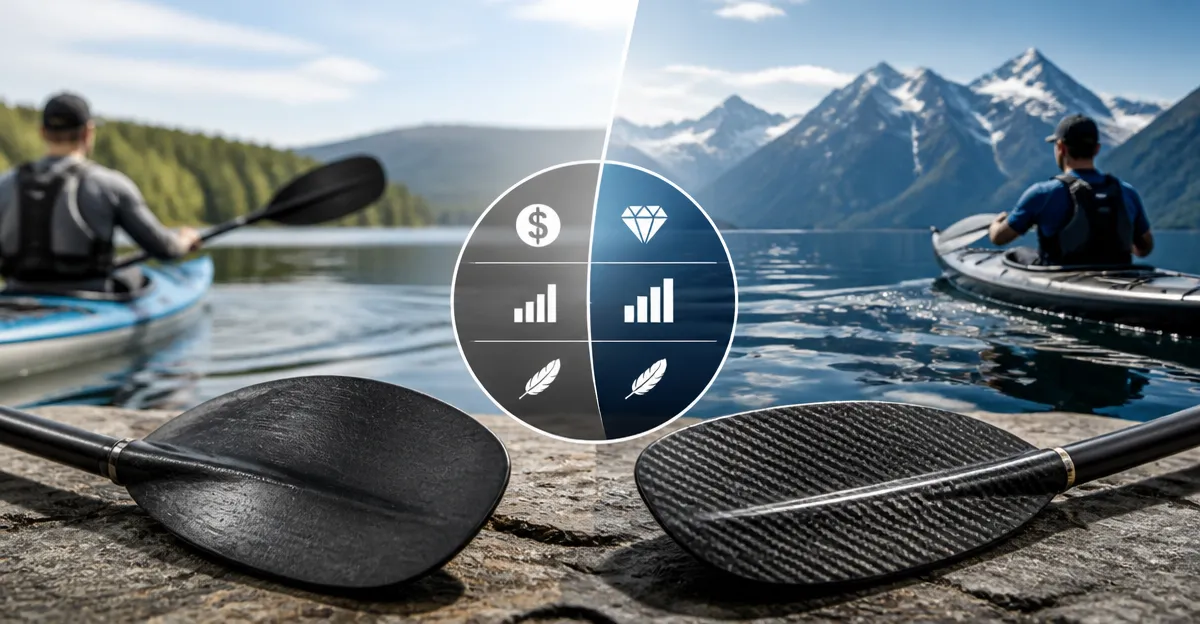
Budget paddles typically employ aluminum alloy shafts with a wall thickness around 1.1 mm, as seen in the OCEANBROAD Kayak Paddle. This construction provides sufficient rigidity for casual use while keeping the price under $30. The inclusion of fiberglass reinforced PP blades adds durability without a significant cost increase. Users report that the shaft remains stable during three‑hour outings, indicating that the material choice delivers acceptable performance for entry‑level paddlers.
Premium options, such as the Pelican Poseidon Angler Paddle, incorporate a two‑piece aluminum shaft with anti‑slip grips and a feathering system that allows precise angle adjustments. Although the price is nearly $65, the added features improve stiffness control and reduce wrist fatigue during extended fishing trips. The integrated hook retrieval system and measurement tape illustrate how premium paddles often combine functionality with performance enhancements.
The Karltion Adjustable Kayak Paddle represents a hybrid approach. It uses a lightweight aluminum shaft paired with a fiberglass blade, offering a stiffness level comparable to higher‑priced models at a cost of $25.59. Customer feedback highlights its “lightweight but does a good job,” suggesting that the material selection provides a satisfactory balance for both beginners and experienced paddlers.
Stand‑up paddleboarding (SUP) paddles often prioritize lightweight construction. The Abahub Adjustable SUP Paddle employs aircraft‑grade aluminum alloy and reinforced fiberglass, delivering a stiffness suitable for flatwater and light surf. Priced at $25.99, it demonstrates that a well‑engineered aluminum shaft can meet the demands of SUP enthusiasts without the expense of carbon fiber. The second Abahub model, priced at $33.99, offers the same material composition but includes a more robust anti‑twist clamp, illustrating how incremental design improvements can justify a modest price increase.
Choosing the Right Length and Angle
Length and blade angle interact closely with stiffness to influence overall performance. A longer paddle, such as the 240 cm (94.5 in) Pelican Poseidon Angler Paddle, provides greater leverage but may feel more demanding on the shoulders if the shaft is not sufficiently stiff. Conversely, the 230 cm (90.5 in) OCEANBROAD Kayak Paddle offers a balanced compromise for paddlers of average height, reducing fatigue while maintaining effective power transfer.
Adjustable paddles allow users to fine‑tune length and feathering angle. The Karltion Adjustable Kayak Paddle features three lockable positions from 0° to 90°, enabling customization for speed or maneuverability. This flexibility is valuable for paddlers who transition between flatwater cruising and occasional white‑water sections. The same principle applies to SUP paddles; the Abahub models adjust from 68 in to 84 in, accommodating a wide range of rider heights and board sizes.
When selecting a paddle, one should measure the distance from the tip of the nose to the center of the cockpit, add six to eight inches for casual SUP use, or add ten to twelve inches for racing configurations. This guideline ensures that the paddle length complements the paddler’s biomechanics, allowing the shaft’s stiffness to be fully utilized without over‑extension.
Real‑World Performance Examples
Consider a weekend lake trip with a family of four. The OCEANBROAD Kayak Paddle proved reliable for three‑hour outings, with users noting that the shrink‑wrap grips remained secure even when wet. The inclusion of a bungee leash and drip rings prevented water ingress, highlighting how thoughtful design can enhance a budget paddle’s practicality.
For a dedicated kayak fisherman targeting larger catches, the Pelican Poseidon Angler Paddle offers a built‑in hook retrieval system and a measurement tape, allowing anglers to record catch size without additional tools. Reviewers praised the feathering system’s ability to reduce wind resistance, a feature that directly benefits paddlers who spend extended periods on the water.
A novice SUP rider exploring coastal bays found the Abahub Adjustable SUP Paddle to be “sturdy, reliable, and great for any paddleboarder.” The paddle’s ability to float when fully assembled added a safety margin, while the lightweight aluminum shaft facilitated easy transport during multi‑day trips.
These examples illustrate that stiffness, when paired with appropriate length, grip design, and ancillary features, determines the overall utility of a paddle across diverse use cases. Budget paddles can satisfy casual needs, whereas premium paddles deliver specialized advantages for demanding activities.
Comparison and Selection Guide
| Feature | OCEANBROAD Kayak Paddle | Pelican Poseidon Angler Paddle | Karltion Adjustable Kayak Paddle | Abahub Adjustable SUP Paddle (Standard) | Abahub Adjustable SUP Paddle (Premium) |
|---|---|---|---|---|---|
| Price (USD) | 29.40 | 64.99 | 25.59 | 25.99 | 33.99 |
| Rating | 4.7 | 4.6 | 4.6 | 4.4 | 4.4 |
| Shaft Material | Aluminum alloy (1.1 mm) | Aluminum alloy (anti‑slip grip) | Aluminum alloy | Aircraft‑grade aluminum | Aircraft‑grade aluminum |
| Blade Material | Fiberglass reinforced PP | Fiberglass reinforced PP | Fiberglass | Fiberglass reinforced | Fiberglass reinforced |
| Adjustable Length | Detachable 2‑section (86‑in, 90.5‑in, 95‑in) | Fixed 240 cm | Adjustable 86.6 in (220 cm) | 68‑84 in (3‑piece) | 68‑84 in (3‑piece) |
| Feathering Angles | 3 locking positions | 0°/65° | 0°‑90° (3 positions) | Not specified | Not specified |
| Special Features | Leash, drip rings, 3 angles | Hook retrieval, measurement tape | Two‑piece buoyant design | Floatable when assembled, anti‑twist clamp | Enhanced anti‑twist clamp |
| Ideal Use | Recreational kayaking, beginners | Kayak fishing, experienced anglers | Flatwater kayaking, beginners to intermediate | Beginner SUP, casual paddling | Beginner to intermediate SUP, travel |
When evaluating options, consider the following decision matrix:
- If budget is primary and paddling is occasional, select a paddle with aluminum shaft and PP blade such as the OCEANBROAD Kayak Paddle.
- If fishing performance and integrated tools are required, the Pelican Poseidon Angler Paddle provides the necessary stiffness and functionality.
- If adjustability and lightweight travel are essential, the Karltion Adjustable Kayak Paddle or Abahub SUP paddles deliver comparable stiffness at lower cost.
- For paddlers who need a floating paddle for safety, the Abahub models include buoyancy features not found on the other products.
Best Practices & Tips
Maintain paddle stiffness by regularly inspecting the shaft for dents or corrosion, especially after exposure to saltwater. Tighten all clamp bolts before each outing to prevent unwanted flex caused by loose connections. Store paddles in a dry environment and avoid prolonged exposure to direct sunlight, which can degrade polymer blades over time.
When selecting a paddle length, test the reach by placing the paddle on the water with the blade vertical; the top hand should rest comfortably on the shaft without over‑extension. Adjust the feathering angle gradually; a small change of 5° can significantly reduce wrist strain during long sessions.
For anglers, practice using the built‑in hook retrieval system on land before heading to the water; this ensures smooth operation during a catch. Pair a high‑stiffness paddle with a low‑drag kayak hull to maximize speed gains, as excessive stiffness on a slow hull may not translate into measurable performance improvements.
Finally, consider a spare paddle for extended trips. A budget paddle such as the OCEANBROAD Kayak Paddle can serve as a reliable backup without adding excessive weight to the gear load.
Frequently Asked Questions
- How does paddle stiffness affect fatigue? A stiffer shaft transmits more power directly to the water, reducing the number of strokes required to maintain speed, which in turn lowers muscular fatigue over long distances.
- Can I use a kayak paddle for SUP? While it is technically possible, kayak paddles are generally shorter and have a different blade shape, making them less efficient for the upright stance required in SUP. It is recommended to choose a paddle specifically designed for SUP.
- Is aluminum inferior to carbon fiber? Aluminum provides adequate stiffness for most recreational activities at a lower price point, whereas carbon fiber offers superior stiffness‑to‑weight ratios for competitive or high‑performance scenarios.
- What is the benefit of a feathering angle? Feathering reduces wind resistance on the blade that is out of the water, allowing smoother strokes and less effort in windy conditions.
- How often should I replace my paddle? Replacement frequency depends on usage intensity and material wear. Aluminum shafts can last many years if not bent, while PP blades may require replacement after several hundred hours of heavy use.
- Do adjustable paddles compromise stiffness? High‑quality adjustable systems, such as those on the Karltion and Abahub models, maintain rigidity through reinforced clamps and lockable joints, ensuring that adjustability does not significantly reduce stiffness.
- Is a floating paddle necessary? For SUP paddlers, a floating paddle adds a safety margin in case the paddle is accidentally dropped, especially in open water. Kayak paddlers may benefit less from this feature but can still appreciate the added security.
Conclusion
Understanding paddle stiffness and its interaction with material choice, length, and feathering angle enables paddlers to make cost‑effective decisions that enhance performance. Budget paddles such as the OCEANBROAD Kayak Paddle provide reliable stiffness for casual use, while premium options like the Pelican Poseidon Angler Paddle deliver specialized features for demanding activities. Adjustable designs from Karltion and Abahub illustrate that flexibility does not necessarily sacrifice rigidity when engineered correctly. By applying the selection guide and best‑practice tips presented herein, paddlers can confidently choose a paddle that aligns with their financial constraints and performance goals.
Products Featured in This Guide
OCEANBROAD Kayak Paddle
Price: $29.40 | Rating: 4.7/5 (7,860 reviews)
Featured for its high‑quality aluminum shaft, fiberglass reinforced PP blade, and value‑oriented price that makes it an excellent entry‑level choice.
Pelican Poseidon Angler Paddle
Price: $64.99 | Rating: 4.6/5 (2,717 reviews)
Featured for its integrated fishing tools, adjustable feathering angles, and robust aluminum shaft designed for serious anglers.
Karltion Adjustable Kayak Paddle
Price: $25.59 | Rating: 4.6/5 (734 reviews)
Featured for its lightweight aluminum shaft, three‑position feathering system, and budget‑friendly price that appeals to both beginners and experienced paddlers.
Abahub Adjustable SUP Paddle
Price: $25.99 | Rating: 4.4/5 (2,611 reviews)
Featured for its aircraft‑grade aluminum shaft, adjustable length, and floating capability that makes it ideal for beginners and travelers.
Abahub Adjustable SUP Paddle
Price: $33.99 | Rating: 4.4/5 (2,611 reviews)
Featured for its reinforced anti‑twist clamp and slightly higher price point, offering additional durability for frequent SUP enthusiasts.